










Water Intrusion Inspection: What Standard Home Inspections Miss
The discovery usually comes too late: After the home inspection and the final walk-through, the basement looked dry. No stains, no odor, no visible cracking. A home inspection documents observable conditions, and the final walk-through is the buyer’s last look before closing — on that day, there was nothing to see.
Fourteen months after the new owners moved in, after one heavy August rain, the remediation quote came in at $41,000.
What the Inspection Couldn’t See
Hairline foundation cracks behind a finished wall. Hydrostatic pressure building for years. Slow-draining perimeter soil that kept spring runoff sitting against the foundation. None of that shows up on a visual inspection done on a dry afternoon in July.
That isn’t a rare story in southeastern Wisconsin — it’s the pattern.
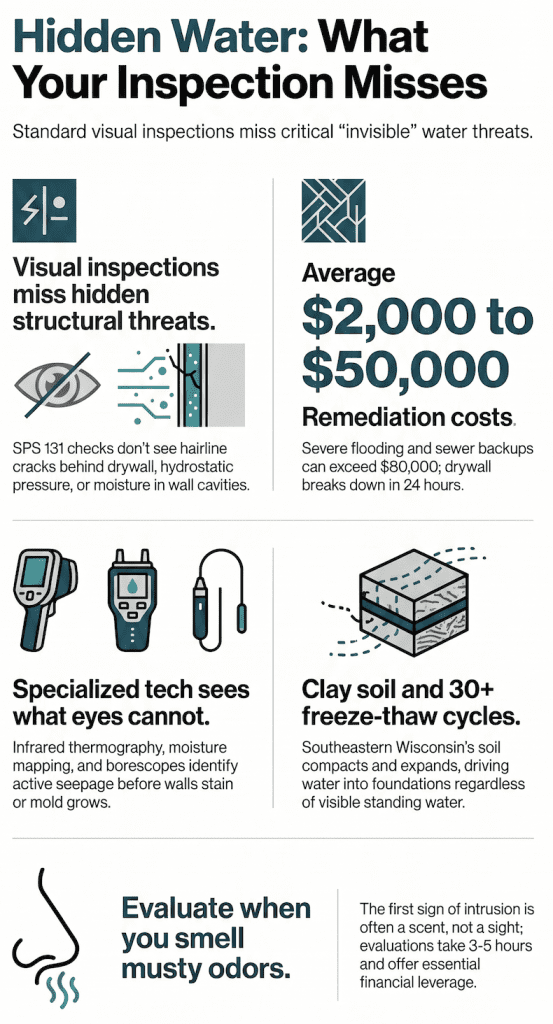
Restoration here typically runs $2,000 to $50,000; severe flooding and sewer backups push past $80,000. Most homeowners learn about it after the bill arrives.
A comprehensive water intrusion evaluation is built to find where moisture gets in and where the foundation is weak.
30+ Years of Foundation Expertise
I’ve spent more than 30 years and completed over 17,000 inspections across the region as a Certified Master Inspector® (CMI®), Certified Infrared Thermographer®, and InterNACHI member.
Our clay-heavy soils compact over time and redirect groundwater, building hydrostatic pressure against foundation walls. That pressure can crack foundations and drive moisture inward whether or not standing water is visible.
Before you call: download our free home inspection checklist. The basement, foundation, and grading sections cover conditions most likely to lead to water intrusion.
Key Takeaway
A comprehensive water intrusion evaluation is designed to identify what may be driving moisture into a home: grading, drainage, foundation conditions, and signs of seepage. It uses moisture meters, thermal imaging, and occasionally a borescope (for a minimally invasive inspection when foundation walls are covered with drywall) to document conditions early, while options remain.
What Has Been Missed in Standard Home Inspections?
A home inspection is a visual, non-invasive inspection per Wisconsin’s SPS 131 Standards of Practice (SOP). The things most often discovered later are the ones that weren’t visible; beyond the scope of the SOP:
- Active basement seepage that hadn’t yet stained a wall
- Foundation cracks that hadn’t yet widened enough to leak
- Window wells that hold water against the foundation
- Early signs of hydrostatic pressure on foundation walls
- Moisture in concealed wall cavities, behind drywall or under carpeting
Foundation Cracks & Freeze-Thaw Cycles
A hairline crack looks harmless on day one, then can expand across freeze-thaw cycles into a pathway for water. Horizontal, vertical, and stair-step cracks suggest the foundation may be moving.
If active settlement is the concern, that’s a Foundation & Structural Inspection — a different service from this one.
Grading & Drainage: The Silent Drivers
Grading, gutters and downspouts are the silent drivers. Flat and reverse grades hold water against the foundation. Where the soil drains slowly, hydrostatic pressure builds whether or not seepage is visible.
When saturated soil freezes — this region sees 30+ freeze-thaw cycles a year — ice expansion can widen existing cracks.
The damage often happens out of sight.
Why Doesn’t a Standard Home Inspection Cover This?
A home inspector documents observable conditions per SPS 131. A comprehensive water intrusion evaluation uses moisture detection equipment, thermal imaging, hygrometer and psychrometer readings, and moisture mapping to assess what isn’t visible.
With your consent, it may also use a borescope: a flexible fiber-optic camera that can be inserted through a small opening to inspect concealed spaces like wall cavities for evidence of moisture intrusion or mold growth without major demolition.
Water Doesn’t Always Show Where It Gets In
Seepage in a basement can trace back to a grading problem fifty feet away, or a downspout discharging against the foundation. That’s why the evaluation looks at how water moves around the house — grading, drainage, and foundation conditions — not just where the stain appears.
What Does Water Damage Cost in Wisconsin?
Two factors move the price up: what got wet, and how long it sat.
Water on sealed concrete cleans up; water in drywall, insulation, and carpet usually means full replacement. Drywall can break down within 24 hours; mold can grow in 24 to 48 hours per EPA guidance.
Evaluation costs a fraction of remediation.
When Should You Schedule a Water Intrusion Evaluation?
Schedule one when you see or smell any of these:
- Water stains on walls or ceilings
- A musty odor in the basement or crawl space
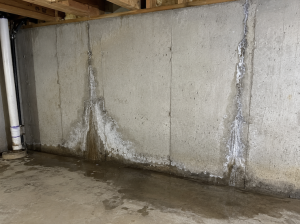
- Efflorescence (white powder) on foundation walls
- Visible mold
- Any disclosure of past water damage on the property
The first sign is often smell, not sight. If past mold is the concern, mold sampling is a separate service that can confirm it.
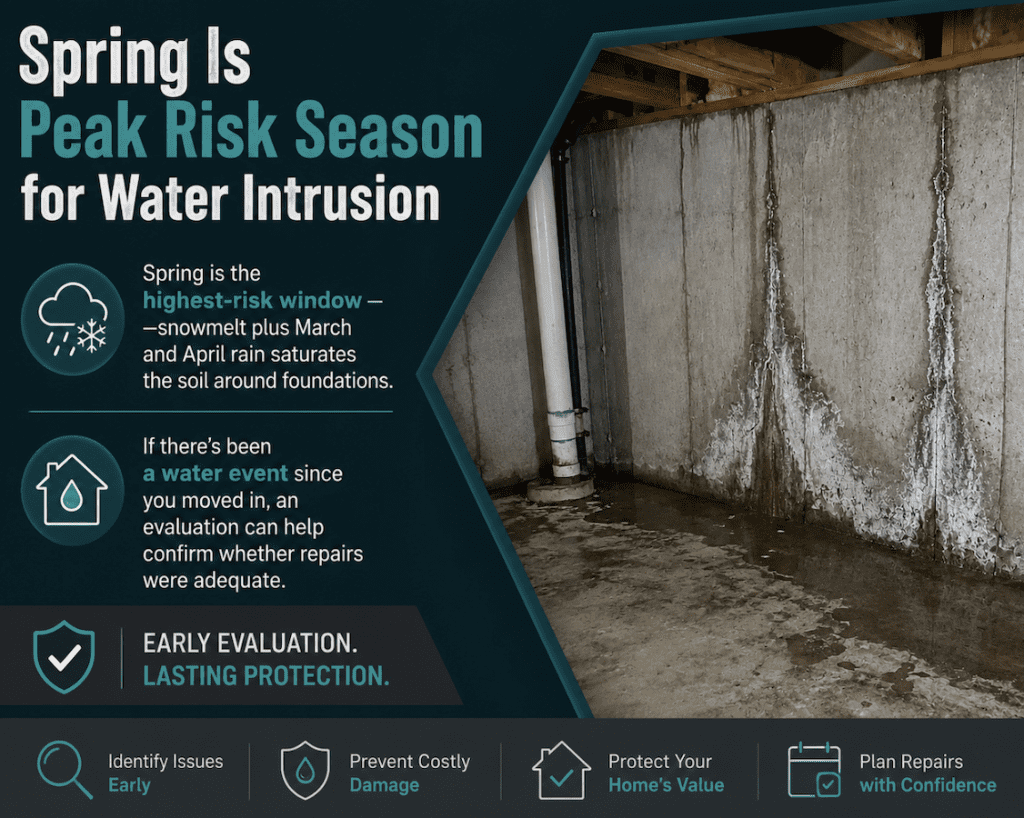
Spring Is Peak Risk Season
Spring is the highest-risk window — snowmelt plus March and April rain saturates the soil around foundations. If there’s been a water event since you moved in, an evaluation can help confirm whether repairs were adequate.
If you’re planning to sell: Evaluating before listing helps with disclosure — Wisconsin’s Real Estate Condition Report requires sellers to disclose known basement and foundation defects. I have often heard sellers state: “There has never been water in my basement,” while I’m looking at basement walls with multiple moisture stains.
Frequently Asked Questions
Does homeowner’s insurance cover water intrusion found after purchase?
Usually not. Most policies cover sudden, accidental water damage from internal sources like a burst pipe. Gradual seepage, flooding, and pre-existing conditions are typically excluded. An evaluation before closing has the most financial leverage.
How long does a water intrusion evaluation take?
Three to five hours for a typical home, longer if there’s more to document. The evaluator runs moisture readings, thermal imaging, and a borescope inspection where appropriate, then documents findings with photos and a written report.
Can a water intrusion evaluation predict future problems?
No, and no honest evaluator should say otherwise. We document current detectable conditions and risk factors. Moisture can hide behind cabinets, drywall, or carpet, so even a thorough evaluation may not catch every concealed issue.
Should I still get an evaluation if the seller disclosed past water problems?
Yes. Disclosure tells you what the seller knows. An independent evaluation can often verify if the repairs were adequate. If mold from past events is the concern, mold sampling is the next step.
What if the evaluation identifies significant concerns?
You get documented evidence you can act on. Buyers use it to support discussions with their real estate professional. Current homeowners use it to prioritize repairs. Anderson Home Inspection doesn’t remediate — we document conditions so you can choose the right specialist.
Protect Your Investment: Schedule Your Evaluation
Water doesn’t wait for a convenient moment to show itself. By the time staining appears on a basement wall, the soil behind it may have been saturated for months and the hydrostatic pressure and water intrusion may be ongoing.
A comprehensive water intrusion evaluation helps protect your investment before closing — or to minimize your financial exposure once you already own the home.
Our Water Intrusion Evaluation is a standalone service. We don’t sell remediation, so there’s no upside in finding problems that aren’t there.
Service Area: Milwaukee, Waukesha, Walworth, Racine, Kenosha, Ozaukee, Jefferson, Washington, and Rock counties.
Get Started
Call (262) 534-5075
For structural concerns, see our sister site andersonfoundationinspection.com
This assessment follows the guidelines of WAFRAP, Wisconsin UBC Section 630.50, and ANSI/IICRC S520 — it represents the evaluator’s observations, not a guarantee of completeness.