






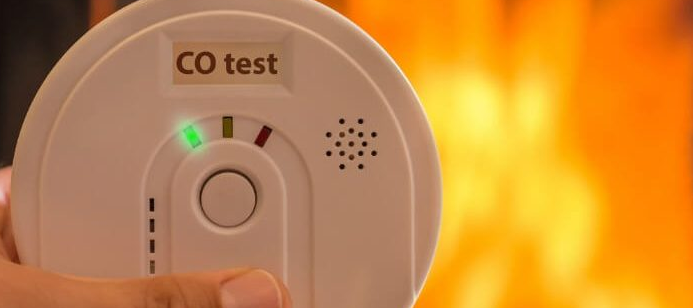
Furnace Safety in Heating Season: Don’t Rely on CO Detectors Alone


It’s heating season. Don’t “just” depend on carbon monoxide (CO) detectors. Is your furnace truly safe?
I began inspecting homes in Wisconsin more than 25 years ago. From the beginning, I tested furnaces for carbon monoxide—even though CO testing is beyond the official scope of a Wisconsin home inspection. I’ve always believed in offering more than the minimum standard.
Low CO Readings Do Not Automatically Mean a Safe Furnace
For years, there was a common belief in parts of the real estate community that if a CO reading was low, the furnace was safe.
That is not necessarily true.
Safety is not just a snapshot in time. It’s about risk—and risk increases as a furnace ages.
- A newer furnace may show elevated CO in flue gases but pose minimal exposure risk.
- A 20-year-old furnace may show low CO readings because it was recently tuned—but still have a cracked heat exchanger.
If a furnace is near or past its design life, the risk of failure and CO exposure increases significantly.
What I Focus on During a Furnace Inspection
During training with Focus on Energy and the Building Performance Institute, I learned that testing protocols and “acceptable” CO levels vary among organizations.
Today, my inspection emphasis includes:
- Signs of air leakage at the plenum
- Corrosion inside the furnace cabinet
- Scorching or pitting near the heat exchanger
- Burner rollout in older units
- Standing water inside the cabinet
- Whether the furnace is at or beyond its expected lifespan
Planned obsolescence is real. Furnaces do not last forever.
When I observe conditions that suggest elevated risk, I recommend Further Evaluation by a Qualified HVAC Specialist.
Home Inspectors vs. Specialists
I often hear: “You’re the expert.”
Home inspectors are more like general practitioners. We identify symptoms and warning signs. Specialists diagnose and treat.
It’s important to understand the limitations of a home inspection. When we see gray-area conditions—signs that something may indicate a more significant concern—it is appropriate to recommend further evaluation.
A Real Example
I once received an email from an attorney four days after inspecting his home.
During the inspection, I noted staining above the furnace below the A/C condensate line. I explained that moisture dripping onto a heat exchanger could cause cracking, potentially allowing hazardous carbon monoxide into the home.
He followed my recommendation and hired an HVAC contractor for further evaluation.
The result? A cracked heat exchanger was confirmed. He thanked me for saving him $3,500 in furnace replacement costs—and potentially far more in safety consequences.
Why CO Testing Alone Isn’t Enough
If a furnace has been recently serviced, burners may be operating cleanly and CO readings may appear acceptable.
But depending on the crack location—bottom, back, or seam of the heat exchanger—CO levels may test low at that moment.
That crack will grow.
The risk will grow.
Relying solely on a carbon monoxide test is like testing for mold the same day a basement floods. You may get a negative result—not because the problem doesn’t exist, but because it hasn’t fully developed.
The Bottom Line
Carbon monoxide detectors are critical. But they are not the only line of defense.
A cracked heat exchanger can enlarge over time, increasing the risk of dangerous CO exposure to you and your family.
Don’t depend solely on a CO reading to determine furnace safety.
Be proactive. Understand the warning signs. Know when to request further evaluation.
I hope this helps.
Be safe.
Donn Anderson
Anderson Home Inspection
Certified Master Inspector – Since 1995
